

Over the last twenty years I've sat across the table from hundreds of trade business owners. Most believed the answer was simple—win more work. More jobs. More vans. More staff.
But here's what I've learned. Growing sales doesn't automatically grow profit. In fact, some of the busiest businesses I've worked with have been the least profitable.
Most trade business owners chase one number: sales. But profitable growth comes down to two things: having the right people and measuring the right numbers.
The Growth Trap
The work usually isn't the problem. What's missing is visibility. Revenue climbs, yet the bank account doesn't seem to reflect the effort. Most owners can tell you their turnover to the dollar, but far fewer can tell you where they're gaining or losing margin every day.
A Real Example
I've worked alongside an Auckland plumbing business for several years. During that time sales grew by around 30%, gross profit by 51% and net profit by 115%. Marketing played a part, but the biggest improvement came from putting the right people into the right roles, measuring performance consistently and making better decisions every week.
Start With People
Scaling is a people challenge before it's a pricing challenge. Get the right people into the right roles early and everything downstream becomes easier—quoting, scheduling, delivery and cashflow.
Every Number Should Lead to a Conversation
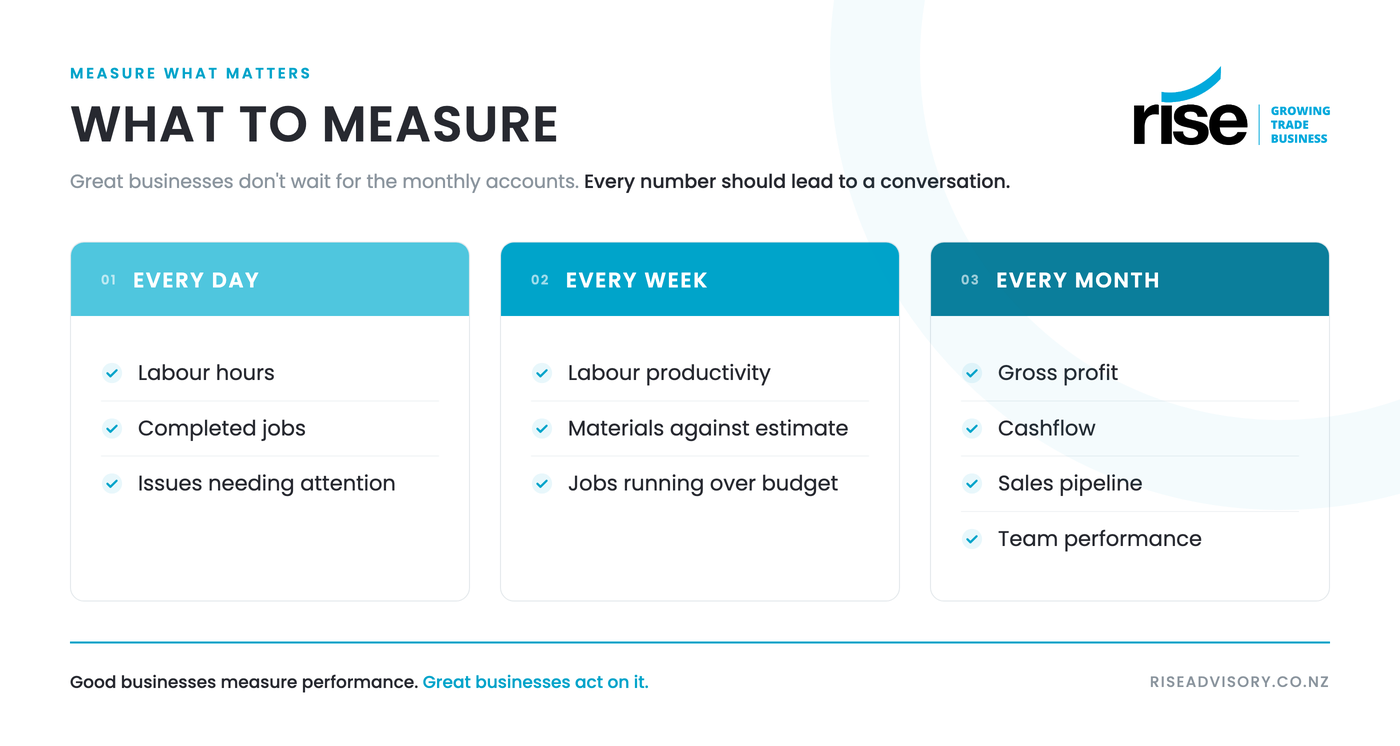
Numbers don't improve businesses. Conversations do. If labour productivity drops, ask why. If quoting accuracy slips, ask what's changed. If gross margin falls, don't wait until the accountant tells you six weeks later. Good businesses measure performance. Great businesses act on it.
Why Margin Matters More Than Most Owners Realise
Here's a simple example.
Take a business with $300,000 in annual fixed costs operating at a 35% gross profit margin. To cover those fixed costs, the business needs around $857,142 in sales.
Now imagine the gross margin slips to 30%. That can happen through underquoting, material waste, rework or poor labour productivity.
Suddenly, the business needs $1 million in sales just to break even.
That's an extra $142.858 worth of work simply to stand still.
Think about that for a moment.
How many additional jobs would your team need to complete just to recover a 5% drop in gross margin?
For most trade businesses, it's far more work than anyone wants to take on.
That's why protecting margin is often far more valuable than chasing more sales.
This is exactly why I encourage clients to review labour productivity, quoting accuracy and gross margin every week—not just when the monthly accounts arrive. By then, the damage has already been done.
Protect Margin Before the Job Starts
Every trade business leaks profit somewhere. The successful ones simply find the leaks earlier than everyone else.
One area where technology can make a real difference is estimating. Digital take-off platforms such as Groundplan help improve quoting accuracy before work begins. That means fewer assumptions, better pricing and greater confidence that the margin you've quoted is the margin you're aiming to achieve.
Discipline Wins
Set targets. Review them consistently. Help every person understand how their decisions affect profitability. When people understand how their work influences the numbers, they begin making better decisions without being asked.
The Takeaway
I've learnt that scaling isn't about becoming bigger.
It's about becoming better.
Better people.
Better visibility.
Better decisions.
When you get those right, growth becomes a result rather than the goal.
Author Bio
Jerome Jacobs is Director of Rise Advisory, where he has spent more than 20 years helping New Zealand trade and construction businesses improve profitability, build stronger teams and create businesses that don't rely on the owner every day. He is the author of Business Mechanics and works alongside business owners to turn practical improvements into long-term results.
Visit: Rise Advisory