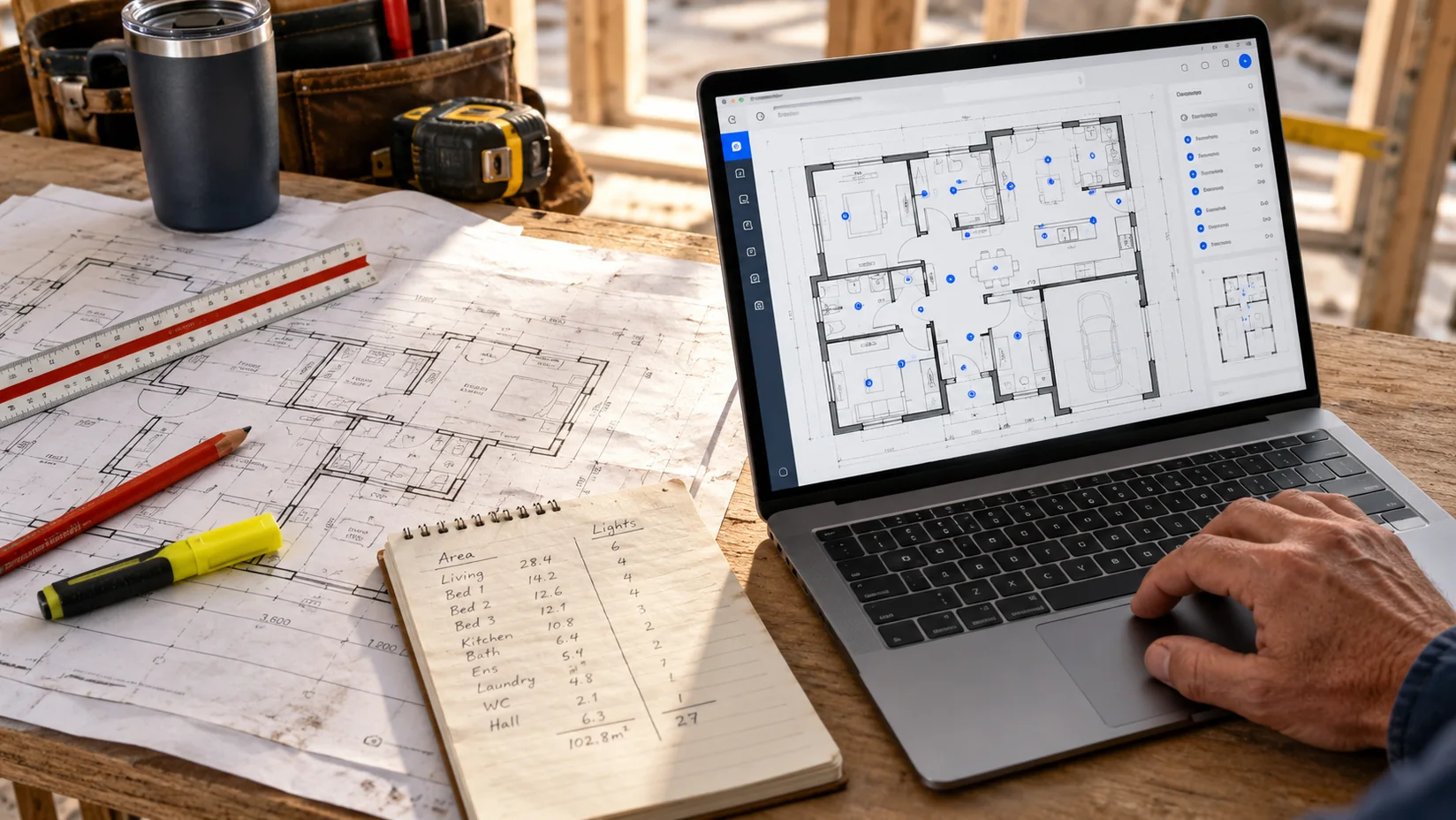

Picture a residential builder pricing a job in 2006. They’d have rolled-up plans on the ute seat, a scale ruler, a highlighter for every trade and a legal pad for tally marks. A mid-size job might take two full days to price, and one misread scale could wipe out the margin before the job even started.
Now picture the same builder in 2026, with plans open on a laptop, an AI counting assist tagging every downlight and door on a floor plan in seconds and a quote out the door before lunch.
That’s how far construction estimating has come in 20 years, and most of that distance has been covered in the last five.
This guide covers how estimating moved from paper to spreadsheets to digital takeoff to AI-assisted counting, what has changed, what hasn’t and where the industry is heading next.
The Paper Era (Pre-2010): Rulers, Rolls, and Red Pens
For most of the 20th century and into the 2000s, estimating was a physical, manual craft. Estimators worked from printed plan sets, unrolled across a table or a ute tray, measuring distances and areas with a scale ruler and protractor.
Counting fixtures, fittings and symbols meant tally marks, coloured highlighters or a running count kept in the estimator's head. Quantities were compiled onto handwritten sheets or, later, typed into basic spreadsheets, then priced against supplier quotes with margins added by hand.
It worked, in the sense that experienced estimators could produce a workable number, and the process forced a genuinely close read of every drawing. But it was slow and brutal on accuracy. A misread scale, a double-counted room or a dropped page in a 40-sheet plan set could sink a bid or blow a budget. Large infrastructure and commercial jobs often needed whole teams of estimators working for weeks just to produce one number.
It is not a coincidence that construction has long been ranked one of the least digitised sectors in any major economy.
McKinsey's global research found the industry's labour-productivity growth has averaged only around 1 percent a year over the past two decades, against roughly 2.8 percent for the world economy as a whole.
Construction also ranked last on McKinsey's digitisation index for Europe. Paper-heavy, fragmented workflows were part of a much broader productivity and digitisation problem across the sector
The Spreadsheet Transition (2010-2018): Excel Takes Over
The rise of the personal computer and, specifically, Microsoft Excel changed estimating faster than anything before it.
Estimators could enter quantities once, apply formulas across a whole trade and reuse pricing structures from job to job instead of starting from a blank sheet every time.
Errors dropped, speed improved and by the end of the 2010s, the spreadsheet was the default estimating tool for most small and mid-size trade businesses.
It is a habit that has stuck. As recently as 2024, a peer-reviewed industry study found that roughly 85% of construction professionals still use Excel for estimating and costing in some capacity, as it’s flexible, familiar and cheap.
But spreadsheets don’t solve the core problems of estimating. They have no connection to the actual plan, so every measurement and count still has to be manually re-entered from a drawing.
Version control is a constant headache. “Which spreadsheet is the current one?” is a question every estimator has asked at least once. And a spreadsheet has no idea whether a quantity was measured correctly in the first place. It only knows what it’s told. See our spreadsheets vs estimating software article for more on when Excel still works best and where it costs businesses money.
The Digital Takeoff Era (2018-2023): Measuring On the Plan
The next shift moved estimating onto the drawing itself. PDF-based takeoff tools let estimators measure lengths, areas and counts directly on a digital plan, with the software automatically capturing the quantity as a line item rather than requiring it to be typed in separately.
Scale was set once per plan instead of re-checked with a ruler on every measurement, and the first integrations with job management and quoting software started appearing, so a completed takeoff could flow straight into a quote.
This was the point where estimating software stopped being a niche, expensive tool for large firms and became something a small trade business could realistically run day to day.
The market backs this up, with Grand View Research valuing the global construction estimating software market at roughly USD 1.5 billion in 2024 and projecting it to reach about USD 2.6 billion by 2030, a compound annual growth rate of 10.2% from 2025 to 2030. The same research points to cloud adoption, AI and machine learning as drivers of continued growth.
The AI-Assisted Era (2023-2026): From Counting to Confirming
The most recent shift is also the fastest one yet. Since 2023, AI-powered counting has moved from an experimental feature to a standard expectation in estimating software.
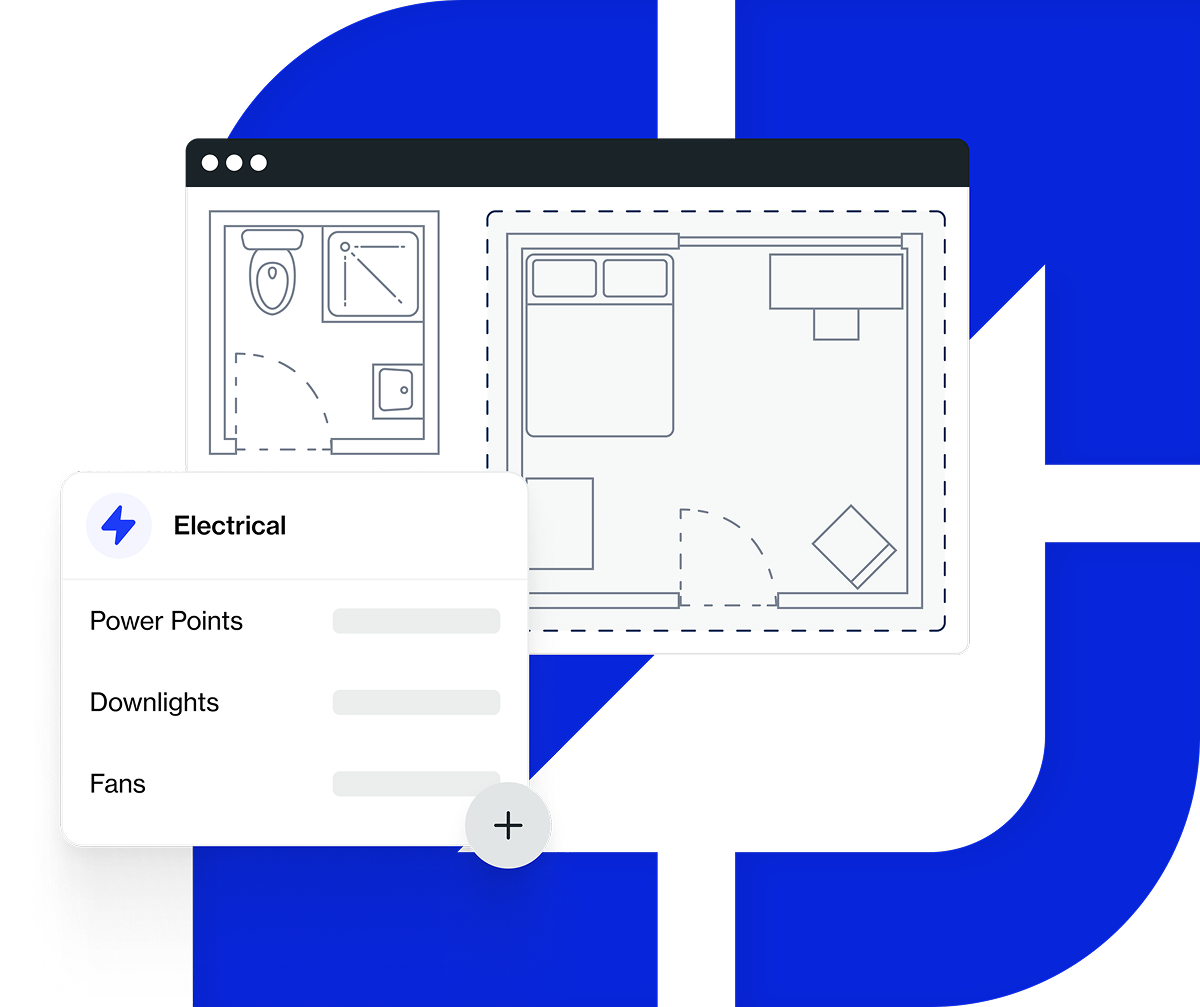
Tools like Groundplan's Count Assist use machine learning to recognise symbols on a plan (power points, downlights, doors, windows, fixtures) and count them automatically, turning what used to be a manual tally exercise into a task the estimator mostly reviews and confirms rather than performs from scratch.
For high-volume, repetitive counting tasks in trades like electrical and plumbing, the manual counting workload has dropped close to zero.
The uptake numbers back up what estimators are seeing on the ground. A 2026 Deloitte report on digital adoption in construction found AI or machine-learning tools are now used by 46% of surveyed businesses, up from around one-quarter when the report first ran in 2023. That is a substantial increase in three years, although Deloitte also notes that many businesses still lack the data systems, interoperability and workforce capability needed to embed digital tools effectively.
If you haven’t compared what a Count Assist-style tool does against a manual count lately, it’s worth seeing it directly on a live plan.
What Hasn't Changed: Judgement Still Wins the Job
Technology hasn’t removed the need for an experienced estimator. AI can count a fixture, but it can’t decide whether a scope note on page 14 changes the quantity on page 3. It also can’t judge how tricky site access will blow out labour hours, or when a client's “like for like” request expands the job.
Software has changed how quickly and accurately quantities are captured, but not what makes an estimate correct: reading the plan properly, understanding the full scope and applying judgement built from real jobs.
The tools have got better at removing grunt work. They haven’t replaced experience, and the estimators getting the most value from AI-assisted tools are the ones using the time it frees up for exactly that kind of judgement call.
Where Estimating Is Heading Next
A few trends are already visible heading into the back half of the decade. RICS describes construction as being at an AI inflection point, with growing data maturity and pressure for productivity creating the conditions for faster adoption, while cost estimating is among the near-term AI use cases it identifies for 2025-2026.
Predictive pricing
Machine learning is increasingly being applied to historical project data to predict construction costs and support estimating decisions.
A 2026 systematic review found a growing body of research applying AI and machine learning to construction cost prediction, while Autodesk describes AI estimating as using historical data to predict project costs and potential overruns.
As these capabilities mature, estimators are likely to see more tools that surface likely costs and flag estimates that sit outside patterns established by comparable past projects.
Live supplier pricing feeds
Live supplier pricing is already beginning to close the gap between takeoff and costing. Platforms such as Buildxact can connect estimates with supplier catalogues and live price files, giving builders access to current material pricing inside the estimating workflow.
As these integrations become more widespread, quantities captured during takeoff can increasingly be priced against up-to-date supplier data rather than static price lists.
Real-time cost benchmarking
Cost benchmarking is already an established construction practice, but richer digital project data should make it more useful inside estimating workflows.
RICS guidance describes benchmarking as a way to use analysed project cost data to inform cost planning, while its AI research points to growing potential in data-rich, predictive construction functions.
Rather than relying only on gut feel or the last comparable job, estimators are likely to have better ways to compare new estimates with historical project data, current cost information and patterns across similar work.
This doesn’t replace the estimator, but it compresses the distance between “the plan” and “an accurate, defensible number”, the same way every previous shift has.
Groundplan at the Leading Edge in 2026
Cloud-based takeoff with AI-assisted counting is where the leading edge of estimating technology sits right now, and it’s exactly where we’ve focused at Groundplan.
Instead of forcing a trade business to choose between a simple tool that’s fast to learn and a complex one that’s powerful but clunky, Groundplan pairs an intuitive, browser-based takeoff workflow with Count Assist's AI-powered symbol recognition, so smaller trade businesses get the same speed and accuracy that used to require an enterprise-grade estimating department.
It is the same evolution described throughout this article, just packaged for the businesses that need it most.
Era-by-Era: How Estimating Has Changed
The Next Era of Construction Estimating
Construction estimating has moved from scale rulers and tally marks to spreadsheets to on-screen digital takeoff to AI-assisted counting. Each change has removed manual grunt work so estimators can spend more time on the judgement calls that win or lose a job.
The next few years will keep pushing that further, with predictive pricing and real-time cost benchmarking picking up where AI-assisted counting leaves off. What won’t change is the value of an estimator who knows how to read a plan properly.
If your business is still estimating the way it did five or 10 years ago, see what 2026-era estimating looks like by starting a free trial of Groundplan.
Frequently Asked Questions
When did construction estimating become digital?
The shift began in the 2000s with early digital takeoff and database tools, accelerated through the 2010s as spreadsheets became standard, and reached the mainstream between 2018 and 2023 as cloud-based, PDF-integrated takeoff software became affordable for small and mid-size trade businesses.
Is Excel still used for construction estimating in 2026?
Yes. Excel remains widely used for estimating and costing because it is familiar and flexible. It still lacks any direct connection to the plan itself, though, which is one reason dedicated takeoff software is increasingly used for quantity capture.
What does AI actually do in construction estimating software?
Today, AI-assisted estimating tools mainly automate the counting and measurement side of a takeoff — recognising and tallying symbols like fixtures, fittings, doors, and outlets directly from a plan. It does not write the estimate itself; an estimator still applies pricing, scope judgement, and site-specific knowledge on top of the quantities it captures.
Will AI replace construction estimators?
Unlikely in any full sense. AI is very good at repetitive counting and pattern recognition, which removes hours of manual work, but reading scope, interpreting ambiguous drawings, and making judgement calls on pricing and risk still require human experience. The role is shifting from manual counting toward review, judgement, and strategy rather than disappearing.
What should I look for in construction estimating software in 2026?
Look for cloud-based access so your team can work from anywhere, direct on-plan measurement rather than a disconnected spreadsheet, AI-assisted counting for repetitive symbol recognition, and integration with your job management or quoting workflow so a completed takeoff flows straight into a quote.