



If you’re a sparky, you’ve probably picked up your estimating skills on the job and made a few mistakes along the way.
As you might have found, the difference between being profitable and working for free (or even paying to finish things up) comes down to how disciplined you are at following each step in the estimating process.
In this guide, we cover the best ways to estimate electrical jobs accurately in the Australian market. We’ll go over the five-step workflow that protects margins, the mistakes that could cost you thousands and where modern electrical estimating software can fit into your day.
The five-step electrical estimating workflow
The five steps in any electrical estimating workflow are reviewing the plan, measuring quantities, applying labour and material rates, adding markup and contingency, and reviewing and issuing the quote. Skipping steps or rushing through them can cost you later on.
1. Reviewing the plan
Starting to measure quantities before fully reading the drawing set is an expensive habit. You could accidentally skip revision dates, assume symbol legends and miss switchboard schedules that are sitting on separate sheets.
Spending a few minutes asking questions at the beginning is much cheaper than taking 10 hours to re-quote when the builder works to Revision C and you priced Revision A.
A typical commercial electrical tender package runs 8 to 12 sheets across general arrangement, single line diagrams, lighting layouts, power layouts, switchboard schedules and the RCBO schedule.
It’s worth checking to make sure the electrical sheets line up with the latest architectural and services drawings. When they don’t, that’s the most common way estimators end up pricing the wrong revision.
2. Measuring quantities
When you’re measuring count, length and area, it’s important to save every count type so the schedule is reusable on the next similar job, rather than rebuilt from scratch every quote.
On a commercial fit-out, the count layer usually breaks into GPOs (singles and doubles), data outlets, troffers, downlights, exit and emergency lighting, sensors, switches and any specialty outlets like cooktop iso, hot water iso or EV charging.
3. Applying labour and material rates
Materials need a current supplier list, which means refreshing your line items every quarter. The main AU electrical wholesalers all publish current price lists, and cable in particular moves with copper.
Each component on a switchboard should also be refreshed, as RCBOs, surge protection (Type 1, 2 and 3) and enclosure prices all move on different cycles. The switchboard line item is where outdated pricing can do the most margin damage on commercial jobs.
In terms of labour, the Electrical, Electronic and Communications Contracting Award (MA000025) sets the legal minimum. The current base rate for a Grade 5 electrician is $28.12 an hour from 1 July 2025, though most sparkies are paid well above that under EBAs or market rates.
Fully loaded, that’s usually 1.5x to 2x the award figure. If you skip the loading, you end up billing labour at cost.
4. Adding markup and contingency
Treat markup and contingency as two separate numbers. Markup is your profit on cost, while contingency protects you from difficult site conditions, plan changes and unknowns. If you put them together, you lose the ability to see where the margin came from.
As a rough industry guide, markup on materials commonly sits in the 15–30% range and labour is often billed at 2 to 3 times the wage cost. Contingency typically runs 5–10% on well-documented commercial work, and higher on retrofits or older buildings where surprises happen more often.
5. Reviewing and issuing the quote
It’s a good idea to have a second set of eyes on every significant tender to catch any mistakes. Then issue the quote in a format the client can easily interpret (labour separated from materials, inclusions and exclusions explicit, validity period stated).
“Significant” usually means anything more than a few thousand dollars (certainly commercial tenders and most residential jobs above $20,000). Quote validity is typically 30 days, dropping to 14 days when copper or specialty switchgear pricing is volatile.
According to the Master Electricians Australia 2025 Industry Benchmark Survey, the businesses with the strongest margins are the ones that treat estimating as a structured process rather than a one-off calculation.
Common Mistakes That Can Cost You Money
These are the most common electrical estimating mistakes and how to fix them.
Missing Items On Plans
Missing items can include overlooked symbols, a takeoff not being updated to reflect a revision, or a switchboard schedule sitting on a separate sheet and never getting cross-checked.
To avoid these issues, carry out a symbol legend check, a revision check and a sheet-by-sheet sign-off before you start pricing.
The items most commonly missed on commercial fit-outs are emergency lighting compliance under AS/NZS 2293, smoke alarms per AS 3786, data outlets shown on a separate layout sheet, MCCBs that only appear on the switchboard schematic and exit signs that get lost between the architectural and electrical drawings.
Missing 8 exit signs on a fit-out is roughly $1,200 in material plus another 2 hours on the labour side once installation and commissioning are factored in.
Underestimating Cable Lengths
One of the most costly mistakes is measuring straight-line distance instead of the actual route. Always measure the routed length of a cable, factor in vertical drops and rises and add a sensible allowance for terminations.
A 30-metre office run drawn straight on the plan can route 45 metres or more through the building once you allow for vertical drops between ceiling and floor mount (around 2.7 to 3 metres per floor), tray bends, pull boxes and risers.
The further the cable has to travel through structure, the wider the gap between the drawn length and the routed length.
Not Accounting for Wastage
Most established electrical contractors build a wastage allowance into cable and small accessories to cover offcuts, damaged components and re-pulls. If you don’t do this, you’ll absorb it from your margin.
A typical rule of thumb is 10–15% on cable across the board, with complex jobs pushing higher. The items most often left out of the wastage budget are terminations, lugs, plate fittings and conduit fittings. These are small individually, but they add up across a commercial job.
Outdated Material Pricing
If your spreadsheet hasn’t been refreshed since the last quarter, every quote you issue is exposed. A quarterly check on your top 50 line items keeps the worst surprises at bay.
If you’ve outgrown spreadsheets completely and they’re contributing to mistakes like these, here’s when it makes sense to switch from spreadsheets to estimating software.Cable and switchgear are the two categories that move most. Cable tracks copper prices and can swing several percent in a quarter, while switchgear shifts more slowly but is large enough by line value that small movements matter. Lighting and accessories tend to be more stable.
Bundling Labour with Materials
Many contractors deliberately don't itemise labour and materials on the customer-facing quote, and there are good reasons not to. Showing the split invites line-by-line negotiation, exposes more of your pricing structure than you want and shifts the conversation from "is this the right job for the right price?" to "why is your labour rate so high?"
But internally, it’s a different story. When labour and materials are bundled into a single number in your costing, you can't see where your margin is coming from or where it's leaking. The way to fix it isn’t to itemise everywhere but to itemise internally and decide separately how to present it to the customer.
Most job management systems handle this well: you itemise everything for your own reference, then display a single grouped figure on the quote. You keep full visibility on your end without giving the client a roadmap to pick apart your pricing.
On a typical commercial electrical tender, the rough split is around 40% materials, 50% labour and 10% subcontracted work, so labour is usually the largest line by value. Without seeing it as its own line internally, it's impossible to track where the job actually made or lost money.
Digital vs Manual Takeoffs for Electrical Work
With digital takeoff software, you measure directly on the PDF plan, counting fixtures and measuring cable runs on-screen rather than on paper. For commercial electrical work, this can reduce takeoff time by 3–5x compared to manual measurement.
When Manual Takeoff Makes Sense
Manual takeoff still has its place. On a small residential job where you can eyeball the count in five minutes, the labour cost of using software is higher than the saving. But once you’re in mid-commercial territory, the numbers change.
How Digital Takeoff Can Help
A manual electrical takeoff on a 200-fixture commercial plan typically takes 2–3 hours. You print the plan, mark off counts with a highlighter, tally in Excel, then transcribe the totals into the quote. Every transcription step is another chance for a mistake to happen.
A digital electrical takeoff replaces the highlighter and the spreadsheet with one continuous workflow. You can open the PDF in a cloud-based estimating tool, calibrate the scale once, then count and measure on-screen.
Quantities feed directly into the pricing sheet, and if you layer in AI-assisted counting — Groundplan's Count Assist, for example — the same 200-fixture commercial plan can be completed in 15-20 minutes.
A 200-fixture commercial fit-out typically breaks down to around 80 GPOs, 60 troffers, 30 exit signs, 20 sensors and 10 switches. Manually marking that up with a highlighter and tallying in a spreadsheet is the work that takes 2–3 hours. AI-assisted counting handles the same plan in 15–20 minutes.
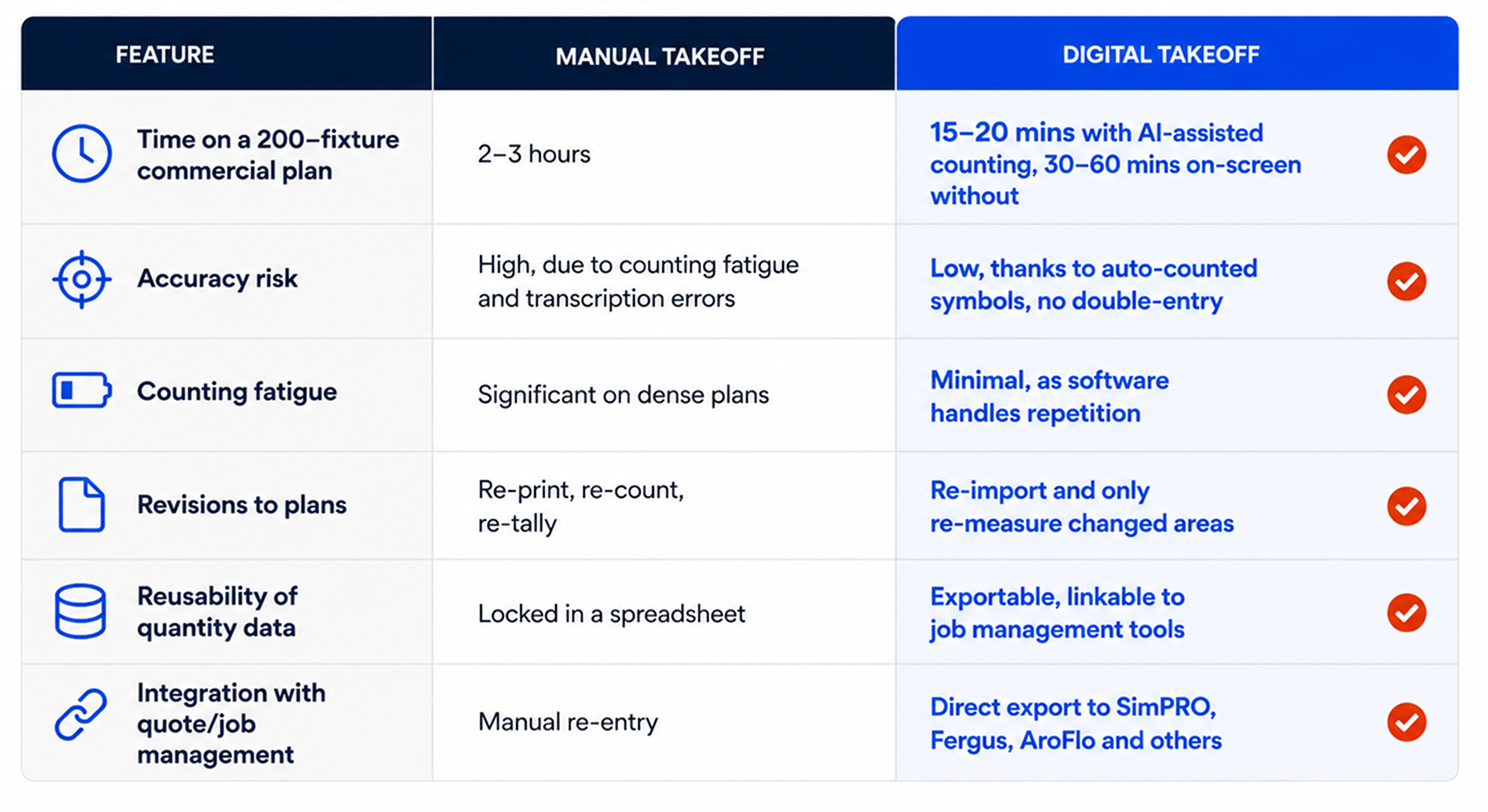
Greater accuracy is as important as saving time. Australian Bureau of Statistics data on the construction industry puts building construction on a single-digit operating margin, with expenses growth since 2020-21 putting pressure on industry profits.
Counting errors in tender pricing are one of the most preventable causes of margin loss. First Choice Electrical reported 70% faster quoting after making the switch from manual takeoffs.
How Groundplan Fits the Electrical Estimating Workflow
Our count, length and area tools work directly with the three measurement actions in an electrical takeoff (counting fixtures, measuring cable runs and calculating area-based items like ceiling lighting layouts).
The tools are built for sparkies who quote off plans (like residential and commercial projects, fit-outs, new builds and light commercial work), not for tradies who mainly do reactive call-outs and repairs.
Every fixture, device, sensor and outlet is counted, with custom symbols you can set up once and reuse across every job. Each cable run, conduit and tray length is measured along the routed path rather than a straight line. Area measurements are also given for ceiling lighting layouts, slab penetrations and zone-based items.
On a typical commercial fit-out, the count layer handles GPOs, troffers, exit signs, data outlets and sensors. The length layer covers cable runs, conduit and tray on the routed path. The area layer maps lighting zones and any zone-based commissioning items. The takeoff then feeds into your quote in one workflow rather than four.
For commercial plans with hundreds of repeated fixtures, our Count Assist tool uses AI to do the counting for you. It flags symbols, lets you confirm or adjust and pushes the totals straight into the takeoff. The same 200-fixture commercial plan that takes 2–3 hours manually can be completed in 15–20 minutes. See how Count Assist works on a commercial plan.
The takeoff then connects to where the rest of your work already lives. Groundplan integrates with SimPRO, Fergus and AroFlo, so quantities feed straight into the job management workflow. It also links to Xero, QuickBooks and MYOB on the accounting side and there’s no double-handling, so the estimate becomes the quote, which becomes the job.
Frequently Asked Questions
How long should an electrical takeoff take?
For a small residential job, about an hour. For mid-commercial work (e.g. a fit-out with a few hundred fixtures), 3–6 hours manually or 1–2 hours digitally. Large commercial plans could take a full day manually, while AI-assisted counting can bring that down to under an hour.
What’s the difference between electrical estimating and electrical quoting?
Estimating is the internal cost calculation, meaning what the job will actually cost you to deliver. Quoting is the document you present to the client. The estimate informs the quote, but they aren’t the same thing, and conflating them makes it harder to track the real margin.
What software do electrical contractors use for estimating in Australia?
The main options in the AU market include Groundplan (multi-trade, takeoff-led), Countfire (electrical-only counting) and Buildxact (broader builder workflow). The right choice depends on which job management or accounting tools you already use and whether you want a focused takeoff tool, an electrical-specialist counter or a general builder system.
Can AI do electrical takeoffs?
Yes. For counting fixtures on commercial plans, AI is now reliable enough to do the heavy lifting in 15–20 minutes on a job that used to take hours. What AI still can’t do is read between the lines on a specification, judge a tricky site or apply the kind of experienced commercial judgement a senior estimator brings. Count Assist is a working example.
What markup should an electrical contractor use?
There’s no single right number, as it depends on your overheads, the type of job, the client and the risk profile. As a rough industry guide, markup on materials commonly sits in the 15–30% range and labour is often billed at 2 to 3 times the wage cost. The more important discipline is to treat markup and contingency as two separate numbers, rather than rolling them into one figure.
Tightening Up Your Estimating Process
Electrical estimating isn’t the most glamorous part of the business, but it decides whether or not the work pays. The sparkies consistently making money treat estimating as a workflow with five clear steps instead of a guess based on what last week’s job cost.It’s about getting the workflow right, keeping your pricing current, and separating labour from materials. Then you can make sure you’re using the tools that match the scale of the work (paper for the small jobs, digital for everything else and AI-assisted counting for the commercial plans where ticking off hundreds of fixtures has become the bottleneck). Groundplan is one part of the toolkit that helps electrical businesses succeed.If you’d like to try it out, start a free trial, upload one of your own electrical jobs and run a takeoff using count, length and area. The trial includes unlimited free training with a sales rep who’s worked in the trades.


